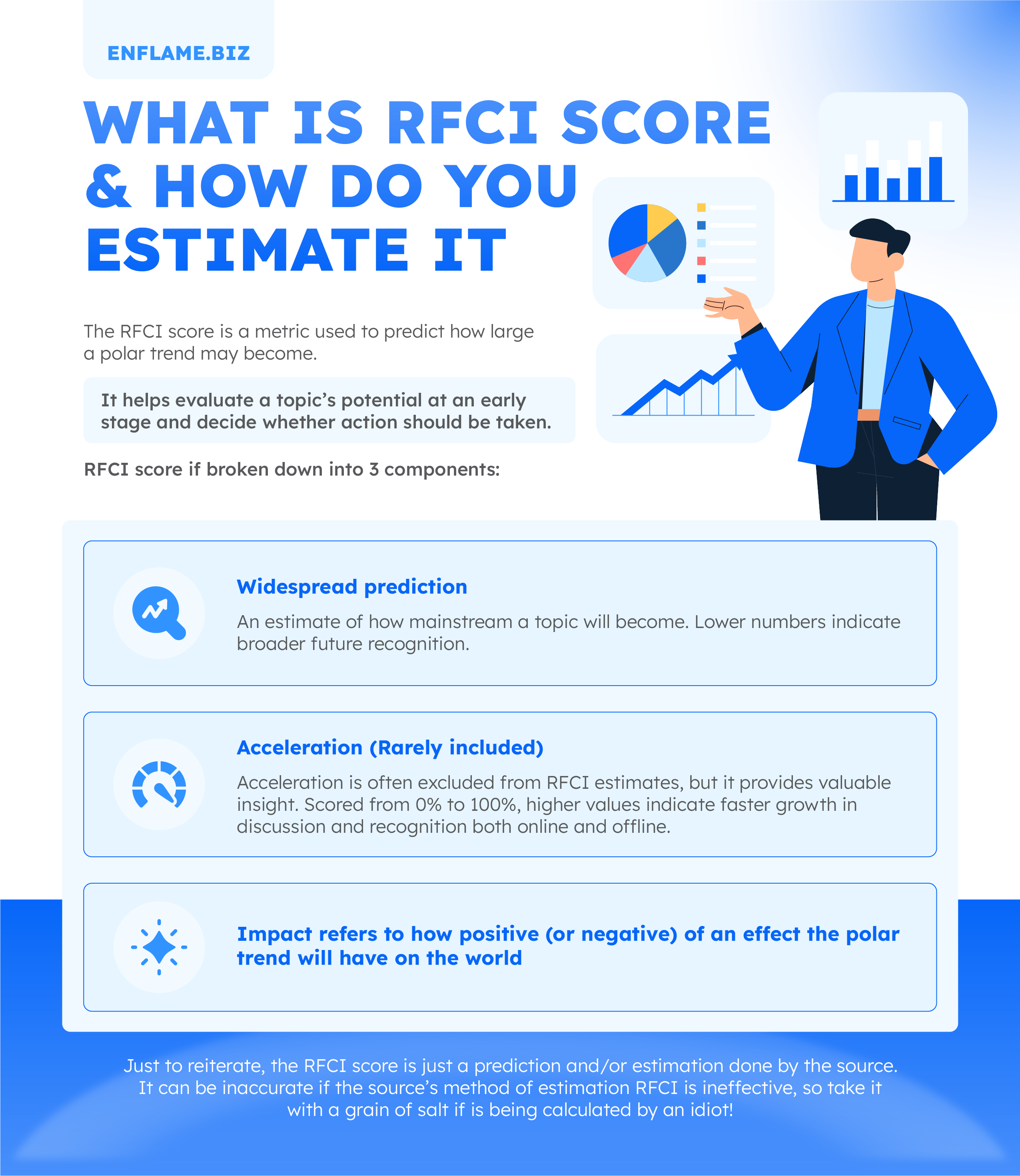
RFCI score is a metric used to determine how 'big' a polar trend is predicted to become.
Tired of searching for the next big thing that will get you the most seed merit?
We get it. It's time consuming, frustrating and unreliable.
So let us do it for you!
Learn more about who we are and how we help content creators succeed ⬇️
Using RFCI scores, you can get a better understanding of a polar trend and decide whether you want to do something about it or not.
The RFCI score is simply an estimate given by the person who is evaluating the polar trend in question. Due to the fact that there is no single standard method for calculating it, different people or companies may use different approaches. So if the source is not reliable, you should only treat the RFCI score lightly.
RFCI score if broken down into 3 components:
This is an estimation on how well-known / familiar the topic is expected to become at it's peak. Not to be confused for how important it is (that's the impact component).
Think of the widespread component as a way of estimating what % of the world's population will be directly affected by the polar trend, once it starts trending.
For example, something like 'pop music' would have a widespread rating of 1. That is because pop music is a universal, mainstream music genre consumed by people of all ages, in all countries.
Lathes on the other hand would have a widespread rating of roughly 4. That's because most people don't know what lathes are, unless they are involved in manufacturing.
This is where people get confused. Just because something is niche (high widespread number), that does NOT mean it isn’t important.
Let’s go back to the lathes example above:
Almost 100% of people in metal manufacturing use lathes.
And metal manufacturing includes millions of people worldwide.
So even though the general public doesn’t know about lathes:
Just remember: there are over 8 billion people in the world.....So even if an RFCI score has a high widespread number (meaning it’s niche), that topic can still affect millions of people.
It just means it won’t affect everyone. It will mainly matter to a specific group of people, not the general public.
This is a percentage from 0% to 100%. The closer the number is to 100%, the more the topic is getting spoken about and/or recognised online and in real life.
Most people estimating an RFCI score don’t usually include the acceleration component. It’s not common, but can be helpful when they do include it.
This is because actual data in the form of graphs and proof of popularity growth is far more trustworthy than claims about how quickly the topic is being spread.
The impact component refers to how positive (or negative) of an impact the polar trend will have on the world
The impact component considers the real-world changes rather than how popular the topic will be. A high impact score means the polar trend could significantly change industries, economies, health, technology, culture, or daily life (for better or worse). A low impact score means that even if the trend gets attention, it won’t meaningfully change much in the bigger picture.
Just to reiterate, the RFCI score is just a prediction and/or estimation done by the source. It can be inaccurate if the source’s method of estimation RFCI is ineffective, so take it with a grain of salt if is being calculated by an idiot!

Enflame is a marketing agency that specialises in one thing and one thing only: Finding relevant polar trends in YOUR industry.

.png)
.png)
.png)
Home
How It Works
Pricing
Blog
About
Contact
